Index
YouTube Curation: The Easiest Way To Create High Quality Content For Your Niche Sites - RankXL
- How to transform popular youtube content to blog post
Pay attention to the view count. Choose videos with a lot of views because that’s what people are interested in.
View Count/Day = Strong Youtube
The first thing we’re going to do is re-write the title into one that’s a little simpler and more search engine friendly.
- Extracting Content
The best part about YouTube curation is that we don’t have to sit there and come up with a rough outline for our article. That’s one of the most dreadful parts of the writing process: figuring out what to write about.
Here, we already know what we’re going to write about: whatever’s being explained in the video.
For our home improvement video, we’ll watch the video and list out all the required equipment and supplies. Then, we’ll list out step by step the process of fixing these porch columns.
Add thoughts/opinions, and even expand upon what’s explained in the video.
You should be able to pour out 500 words easy doing just that.
Why Your Page Isn't Ranking: A Quick Content Quality Check - RankXL
- Do you have the keyword in your title?
- Are your articles full of unnecessary filler content?
- Are all your articles under 1000 words?
- Do you think about search intent?
How to Start a Blog and Make Money (Free Guide)
- MY SIMPLE INSTRUCTION TEMPLATE to writer
Thank you for picking up this order.
Please research, list and describe all viable alternatives to X.
The description should adequately explain what it does and how it’s the same, better, and worse than X.
The introduction should explain what is X. The body of the article sets out viable alternative options to X.
Please do NOT write a conclusion.
The headings (the options that are the alternatives) should be h2 format and enumerated.
Please include a link to each option you find.
Do not include pricing information.
Thanks again,
Jon
How To Make Money Blogging (A Complete Step-By-Step Blueprint)
- BuzzSumo
- Quora
- Youtube
How to Start a Blog and Make Money (Free Guide)
Type of Content:
- LISTICLE The listicle is an article that is a list of something. An example is “10 best beaches in the world”. Buzzfeed publishes a lot of these articles and it’s the foundation of its success.
- HOW-TO / TUTORIALS If you know how to do something and can get photos of you doing it (and/or video), this is a terrific type of article.
- IMAGE GALLERIES I use photo galleries extensively on 2 of my niche websites. I also publish a hairstyles site that publishes photo galleries. This works in visual niches such as interior design, beauty, cars, tattoos, etc.
- NEWS Most niches have news you can cover. I’m not big on publishing a news site, but it’s a viable type of content. If you stay up-to-date in your niche, when a story breaks, you can cover it. Some sites are “news” focused and only publish news. I don’t run these types of sites, but it’s pretty popular. An example is a niche site that covers a certain sport. Most sports content is news.
- PRODUCT REVIEW If you own products relevant to your niche, you can review them. These can earn money if you provide an affiliate link to the merchant that sells them. This is a very popular way to generate revenue from a website. Look around your home; no doubt you own plenty of stuff you can review.
TIP: An offshoot of the product review article is a “vs.” article, which is an article that compares 2 to 3 products. These are very long tail in nature which I like because you can start getting a trickle of targeted traffic to your website fairly quickly.
- TIPS ARTICLES This is a form of a listicle. You can list out tips to achieve something. An example would be “30 dining room design tips”.
- CHECKLISTS I should do these because they can be popular and helpful, but haven’t gotten around to it. However, you can easily create checklists for most topics. Examples include “car buying checklist”, “moving checklist”, “spring cleaning checklist”, “house buying checklist”.
- INTERVIEWS Experts and other bloggers love being interviewed because it’s easy and free exposure. What you do is put together a series of questions and then contact experts asking if they would like to be interviewed. You can restrict it to one expert or multiple experts (usually called a round-up).
- PERSONAL STORIES You can write about your personal experiences. This works better in some niches such as travel where readers will be interested in your experience.
- BEST-OF You can put together the “best of” or “top 10” of pretty much anything. If you include products, you can provide affiliate links for revenue. But it need not be products. It can be movies, locations, services, websites, etc.
- CURATED CONTENT Curated content is when you take a little bit from multiple pieces of content on the web and create a comprehensive article. It could be “25 cleaning hacks” which could include YouTube videos (which you’re permitted to embed on your website), snippets from other bloggers, etc. Just be sure to give attribution with a link crediting the source. FYI, you don’t need to give attribution with embedded YouTube videos.
- DEFINITION ARTICLES Some concepts are complex and so what I call “definition articles” can be a great type of content. I’m not talking about starting a dictionary. I’m talking about writing in-depth articles that explain more complex concepts.
Example: What is a niche website?
That alone would make up an entire article.
- OP-ED Op-ed stands for opinion editorial. It’s an article where you state your opinion on an issue and set out support and opposing views. These are fun to write because who doesn’t like to put forth an opinion?
- CASE STUDY A case study deconstructs a result so that readers understand what happened to achieve a particular result. Case studies are common on business-oriented blogs like this site.
An example would be a case study of how a blogger grew their blog to 1 million monthly visitors. It would set out the steps taken along the way.
Case studies can be used in many niches such as weight loss, bodybuilding, business, marketing, lawsuit, addiction, dog training, etc.
You can write a case study on a result you achieved or the result another person or entity achieved. Many bloggers do both. If you profile another person or entitys result, you just send them a list of questions that they answer. From that you construct the case study.
ROUND-UPS
There are many forms of round-ups. Here are a few common approaches:
Answers from a large number of “experts” to one or a few questions. Each person’s responses are listed under their own section. You’re no doubt familiar with these since not too long ago every blog in the “make money online” space featured these.
Another concept is to feature a large number of projects under a particular theme. An example would be 40 Bargello Quilts by Expert Quilters. Each featured quilter would have an image of the quilt, a brief write-up about it and a link to the full project. Another example is showcasing a large number of recipes for a particular dish.
INTERVIEWS
Interview articles are answers provided by one expert on a particular topic in the niche. You, as the blogger, reach out to experts in the space and ask if they’d like to be interviewed in written form. If they agree, send them youu questions. They respond with answers. That’s your article.
Another way to do this is to verbally interview them and then get it transcribed. Of course, you can also publish the audio version too.
EPIC GUIDES
This article is an attempt at being an epic guide on how to start a blog that makes money. The aim is to thoroughly cover a top from A to Z. Often it links out to many additional resources on and off-site.
These articles take days to put together and usually target high search volume keywords.
Other terms used for this type of content are “cornerstone article” or “foundation article”. It can also be treated as a niche site landing page that comprehensively covers a topic but leads visitors to other more specific articles on the site.
How I Got 76 Natural Inbound Links to 1 Curated Article
- Target Good Keyword
- Long, very very long
- Unique Content
- Friendly, link back to original site
- Quality
1. “101” Tips: I can only speculate, but the fact it’s huge helps. 101 tips is long. The number “101” pops. While curated, it was a lot of work.
2. Unique content: Another thing I did was I wrote a unique write up for each listing. I didn’t copy and paste from the source sites. I put my own spin on it and then linked out.
3. Targeted a great keyword: I didn’t do much keyword research back then (focusing on social), but by happenstance I targeted a killer keyword. I strongly recommend that you target killer keywords. Do the keyword research. I have other curated articles that don’t target great keywords and they aren’t as successful.
4. Quality: I focused on quality tips. My VA combed through hundreds of tips and sites to find 101 worthy tips to include. In other words, I didn’t settle on the first 101 I found.
5. Pinterest: Finally, and I think this is the biggest reason it attracted many links, and that is it got good traction on Pinterest. The result is the article got solid exposure with other websites and they linked to it. Search traffic quickly followed.
In fact, it was profiled as an example of excellent curated content by a very well known internet marketer. He doesn’t know me and if he does, I doubt he knows I own that niche site. I never brought it to his attention, but I appreciated his link.
My 8-Step Process for Ordering Content So That I Get Exactly What I Want - Fat Stacks Blog
Step 1: Publish an excellent example
I publish one, two or even three outstanding examples of the type of content I want. I hone it and make it as perfect as possible. This will serve as a tangible example for writers to refer to.
An important point here is “the type” of content. I publish 8 or so different types of content. By type I mean it’s an angle that has specific formatting and media. For instance, a round up is a type of content. A list post is a type of content. A gallery is a type of content. A product review is a type of content. Each site will have its own “types of content.” It’s good to identify those types and have a uniform format for them so writers have a “template” to follow.
Step 2: Create a list of topics
This is obvious. You need to create a list of topics. I prefer long tail, but you publish on whatever you like. The key is that your writers know the topic that you want to cover.
I also make it clear what type of content it is so once they’re familiar with the format, they know exactly how to cover the topic and how to format the article.
Step 3: Video instructions are a necessity
By far the best way to provide instructions is to make a 5 to 10 minute video of you explaining every detail of the example articles you’ve already published. I think it’s helpful to explain why you do what you do so they can understand what you want even better.
Do not assume anything. Comb over the entire examples with video explaining everything.
Video is amazing for both you, the publisher and the writer. The writer gets very detailed instructions. You’re able to provide those detailed instructions with only 5 to 10 minutes of work. You can cover far more ground in a 10 minute video than you can with written instructions.
I use Jing for quick videos.
Step 4: Outline
This is optional, but recommended for longer content. Without a doubt, I get the best content when I provide a detailed outline. I hate making them, but it pays off in the long run.
My outlines consist of all headings and sub-headings. The writers just need to fill in the blanks and get photos when applicable.
I do this for guest post contributors as well.
A good outline takes anywhere from 5 minutes to 20 minutes to put together. It may take longer if it’s a topic that you’re unfamiliar with.
Step 5: Provide resources
You can either show your resources in the video or in your instructions. Regardless, it helps your writers tremendously if you show them where to get the information and to do the research, especially if you’re looking for very specific information.
Of course sometimes you want the writers to do the research, but if you have a batch of resources you use regularly in your niche, provide them to your writer(s).
Step 6: Be Patient
I’m a very impatient publisher. When I think of a topic, I want it published yesterday. Of course writers can’t produce it that fast.
More importantly, keep your eye on the prize, which is getting content that is as close to perfect as possible. This saves you a lot of time and so if you must wait a few extra days, so be it.
Step 7: Give Feedback
This is an important step if you’re going to continue placing content orders. If the content isn’t perfect, say so politely. Place blame on your shoulders that you probably didn’t provide sufficient instructions and then explain what’s wrong and how it should be fixed going forward.
This is one very strong argument for starting with ordering only a couple or few articles. This gives you a chance to give feedback before the massive batch comes in.
Step 8: Place a Bulk Order
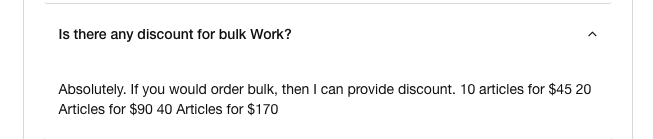
Most writing services will discount the cost per 1,000 words if you order in bulk. If you’re happy with the service and you’re ready to open the floodgates, ask about a bulk discount before ordering. Simply ask if they offer bulk pricing and if so how much you need to order to qualify.
--
How to Curate Content Successfully (with Case Study)
Just to give you an idea of how well curated articles can perform, here’s a brief case study of one of my curated articles on one of my niche sites.
- Topic: 101 X Ideas for Y
- Format: Each of the 101 listings in the article are formatted as follows: Heading / image / my editorial comment / attribution link.
- Word count: 9,500 (it’s a beast – I didn’t skimp on the editorial comments)
- Referring domains (ahrefs): 80
- Organic keywords it ranks for (ahrefs): 1,400
- Traffic: 9,800 visits (last 30 days – December 11, 2017 to January 13, 2018). Google: 686 / Pinterest: 7,901
- Year published: early 2015 (it’s due for a little upgrading)
How to Outsource content creation effectively - Up Fuel
- What Kind of Content you should outsource
I believe the requirement for quality writing is only truly needed when you’re trying to build a website as an authority AND drive repeat readers.
But if you’re searching for information on cotton candy machines do you really need to have a leading authority and unique voice behind the writing to get the information that you need? No of course not, and this is precisely why I’ve gone the outsourcing route for content creation on my niche websites.
- Why OutSource Content:
- The primary reason why I have started to outsource content creation comes down to the time I have available in the day to work. It’s convenient to simply pay for someone else to write the content,
- but I also have domain names in niches where I know little about the subject matter or where I have no interest in learning enough to write about them. These make ideal candidates for outsourcing, especially when I am trying to target search traffic only.
Niche Website Content - Our Process And Providers For Site Content - Empire Flippers
- Primary keyword and long tails are ready to go – This is party of our keyword research. All content being ordered (Whether the primary article for the site or one of the secondary articles) has a Primary keyword and at least 3 long tail keywords to target.
- Order from Fiverr – Log into Fiverr and go to our regular content providers and order the content using the proper script, depending on whether it’s primary or secondary content. (We give our content writers and script away to those subscribed to our email list, check it out here!)
Record the order – Log the Fiverr order number in the Google Doc for quick reference and so we can follow up if the order is taking too long, has been cancelled by seller, etc.
Receiving Content:
- Login to Fiverr and download the file
- Check for duplicate content via Copyscape via paid account – It’s important to note that you should put sections or paragraphs into Copyscape at one time rather than the entire article…you’re more likely to find duplicates this way
- Check grammar and spelling – Our Content Managers are much better writers than the average writers on Fiverr and can quickly make a few edits to the document to improve the overall quality
- Check keyword density – We currently look for the primary keyword to be mentioned once per 100 words or more and the long tails once or twice per article
- Check snippets of the content via exact match Google search – They’ll take 6-10 word strings in the content and search in quotations for those snippets online. This is a more thorough check for duplicate content than Copyscape
- Check for “natural language” in the article – They’re trained to look for content like, “You probably won’t find a better than this. Many people rave about this online because the quality is unmatched. You can pick up a _ for cheap at your local store or even with many online retailers…” This will NOT cut it. If the article is about curling irons, for example, it should read more like, “Make sure you consider the quality of the curling iron before purchase. If you go with one of the cheaper brands, it’s more likely to damage dry hair, or create that unmanageable frizz that everyone hates…”
- Save the content and mark it ready to go in the Google Doc – Once this step is complete, another agent will see that it’s done and ready to be uploaded to WordPress.
Content Providers:
- For example, we’ve found that a full 25% of content that we order is either never delivered or is rejected by our team. (For brand new writers, that number can be as high as 50%!)
- Fivr:
Around 50% chance it is not finished
- Your Time: When factoring in non-delivery, it’s around 45 minutes per order, so around 2 hours 15 minutes per site
Delivery: Anywhere from 2 days to 14 days, depending on whether content is delivered
Textbroker Pricing | Content Prices, Terms and Conditions
- get place to get primary article
- around $9 for a 500 word article
- iWriter: Content & Article Writing Service - Buy Articles
- around $4 for basic and $6 for better quality content
- great for secondary article
Minisite Vs. Authority Site: Content ROI Is Key - Empire Flippers
Assumption:
- Adsense revenue is some what can scale with visitors
- Have a process to calculate Content ROI
ROI = Content Earning* PageView/ Total Page View
Content Role:
- Primary Content, your home page, majority people landing
- Secondary Content, supporting, lower quality
- Git it on Fivrr, $5 each ?
One of the benefits of our approach is that it’s profitable on its own, but once you have enough sites you can really start looking at the data to turn your $0.40 per day earners into $2, $4, $6 per day sites to really maximize profitability. We know by looking at the numbers that the potential ROI is worth it and, instead of taking our website creation team off to work on this task, we can simply hire/order directly for this project.
Ordering Content On Fiverr - Empire Flippers
The Process:
Order Primary Content From Westerner:
1x 500, Budget $5
Order Secondary from other country: Search 2 article
2x 500, Budget $5
- Content Quality Requirement:
If I were to write the articles for our sites myself, I could write a Primary and four Secondary articles in around 2.5 – 3 hours. The content wouldn’t be amazing and I wouldn’t look back at the articles with pride and joy, but it would be enough to reasonably inform the reader and would be 100% unique, making the search engines happy.
Now…you can have those same articles written for you at a cost of $15.00 or less by ordering through Fiverr.com.
is that true ?
- Search Fiverr
- Check the seller’s feedback to find real-life examples of the content in action.
- Too Good To Be True? – It probably is! We’ve found that anyone offering more than 3 articles in a Gig will give you auto-spun PLR, is selling non-unique content to multiple buyers, or won’t complete the gig, wasting your time ordering. A good rule of thumb is no more than 1 article from a westerner and no more than 2 (maybe 3) from a non-westerner.
- Have They Logged In Recently? – Check the user to make sure they’ve been with Fiverr for a while and have logged in recently. Avoid sellers that signed up 1 month ago and haven’t logged in for weeks.
- Check Their Work – Especially for new writers, it’s worth checking CopyScape and making sure their work is original. After the first few orders you can generally spot-check their work. Make sure with CopyScape that you’re using the paid version and check paragraphs, not the entire article. (You’re more likely to find duplicate content this way) If you’d rather not pay for CopyScape, simply take random 5-6 words strings unique to your article and Google search with quotations to find duplicates.
AFP 5: Content Sourcing And Creation For Niche Websites - Empire Flippers
- The process for content:
- do it yourself first
- the ordering/checking/editing
- document your process
- screenshot
- screencast it
- The process is managed
- the labor work is outsourced
- Dont put writers on staff
- Hire 2-3 Writer to write content
- turn the best one for editor
- do it yourself first
What Are PLR Articles and Should You Use Them? | John Chow dot Com